Catch voice outages before your users do.
AutoDialer replays real calls — SIP, RTP, IVR journeys — to continuously validate that your voice services work. The 9 a.m. morning check is over: supervision happens in real time, 24/7.
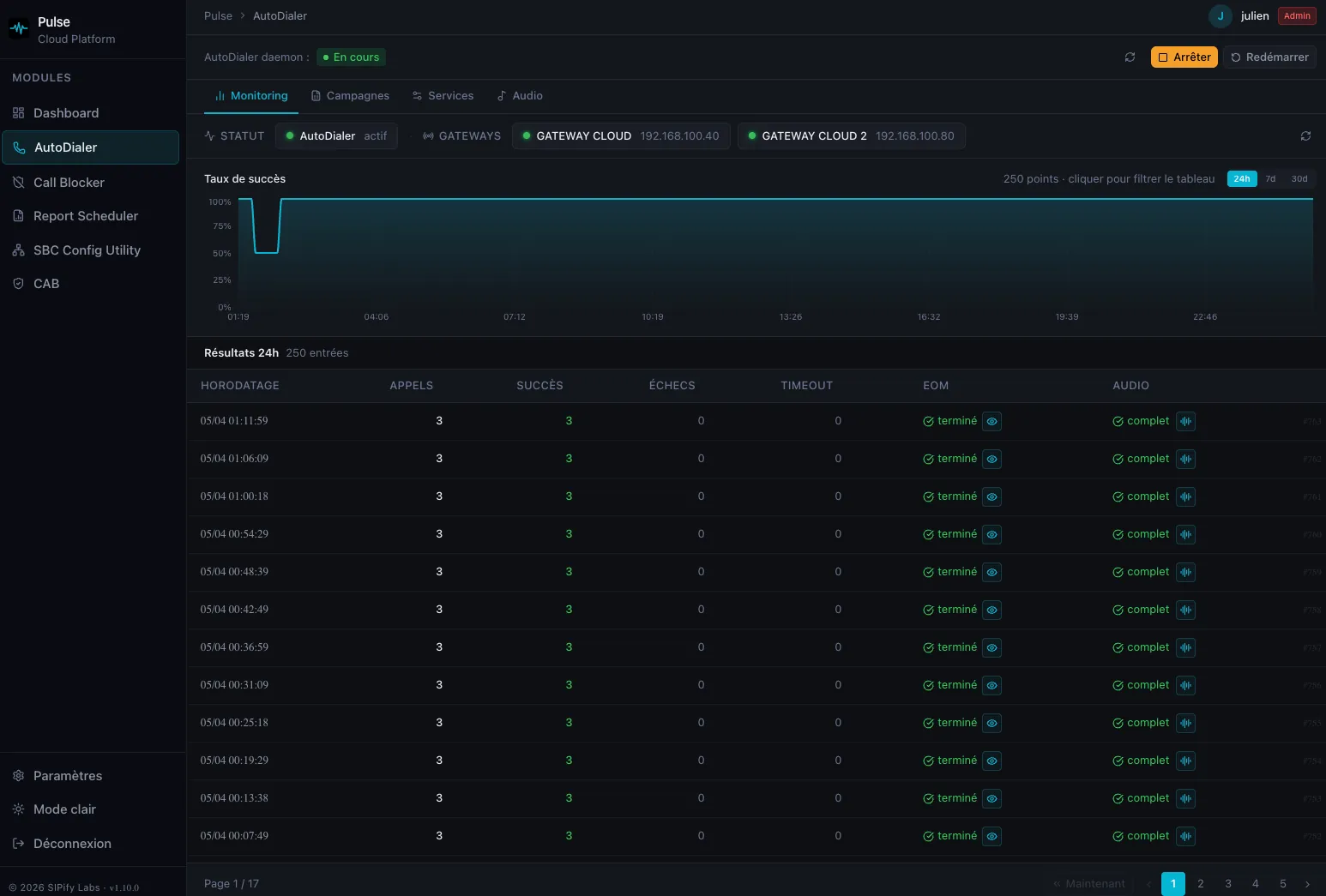
Why technical monitoring isn't enough
Green on the dashboard, red in real life. What network KPIs don't say, AutoDialer catches.
Outages are reported by your users
Intermittent incidents, degraded audio, broken IVR journeys: classic monitoring doesn't see them. Your teams learn about the incident from a ticket, not from an alert.
Reproducing an IVR bug is expensive
Mobilize testers, manually walk through a journey, restart on each fix. Slow, hard to reproduce, impossible to industrialize.
Network KPIs ≠ caller experience
A trunk is "UP", an IVR is broken. Technical indicators measure the infrastructure, not the caller's experience. The end-to-end view is missing.
Validate that a call goes through, not just that a config file is in place
AutoDialer applies SIPify Pulse's workflow-centric approach to voice supervision: instead of watching counters, we replay the action that matters. A real INVITE, a real RTP stream, a real DTMF keystroke, a real transfer.
Each run produces an explainable OK/KO verdict: SIP code, IVR step reached, measured audio quality. When something breaks, you know what, where, and you can replay the scenario on demand. Diagnosis starts on the first call — the robot's, not the user's.
The flow of an execution
From scheduled campaign to verdict, through the SIPp engine and the report.
Campaign
Frequency, time windows, destinations
IVR scenario
DTMF, validations, optional Vosk ASR
SIPp engine
Real SIP + RTP call via VoiceAI Gateway
Verdict + metrics
OK/KO, MOS, SIP codes, durations
Dashboard + alerting
History, exports, email, webhooks
What you can automate
Scheduled campaigns
Frequencies from 5 minutes to 1 hour, time windows, multiple destinations. You decide what to test, when, and from which entry point.
Multi-step IVR scenarios
DTMF, validations, conditional branching, and optional voice recognition via Vosk. From simple journeys to transfers with REINVITE.
End-to-end quality metrics
MOS score, SIP codes, per-step durations, typed errors. Not just "it rings", but "it sounds good".
Built-in alerting
Email and webhook notifications as soon as a run fails or a quality threshold is crossed. SNMP / MIB on the roadmap.
100% on-prem
Pulse Agent + VoiceAI Gateway. Test calls stay inside your infra, so does the data. Zero internet dependency.
What about load testing?
The embedded SIPp engine isn't only for monitoring: it can also generate volume to validate how an SBC or a UC platform holds up under load. One tool, two use cases — continuous supervision and one-off benchmarking — without spinning up a dedicated test infrastructure.
Manual test runs vs AutoDialer
Why industrialize post-change validation
| Manual test runs | AutoDialer |
|---|---|
| Depends on a tester being available | Runs continuously, 24/7, without intervention |
| A few scenarios covered, never the same ones | All IVR journeys replayed identically on every run |
| Several hours per validation campaign | Minutes, in parallel across all destinations |
| Detection after the incident, by users | Detection before users, immediate alert |
| No usable post-mortem trace | Full history: SIP codes, MOS, IVR step, exports |
| Replaying a bug = remobilizing a team | Replaying a scenario = one click |
Three concrete use cases
Contact center & IVR
Continuously test IVR journeys, harden platform migrations (UCCX, Genesys, Teams), catch breakages before callers do.
Telecom operations team
Industrialize post-change checks: production rollouts, SBC patches, trunk migrations. No more morning check the day after — validation happens overnight.
Voice architect & capacity planning
Generate SIPp load directly from Pulse to validate how an SBC or a UC platform holds up. No need to spin up a dedicated test bench.
Integration in the Pulse stack
AutoDialer relies on two SIPify Pulse building blocks: Pulse Agent for orchestration and scheduling, and the VoiceAI Gateway which embeds the SIPp engine. Execution goes through an internal API — no more hand-rolled SSH to launch a test.
Results are stored in a local SQLite database, exportable, and surfaced in the Pulse UI. No data leaves your infrastructure.
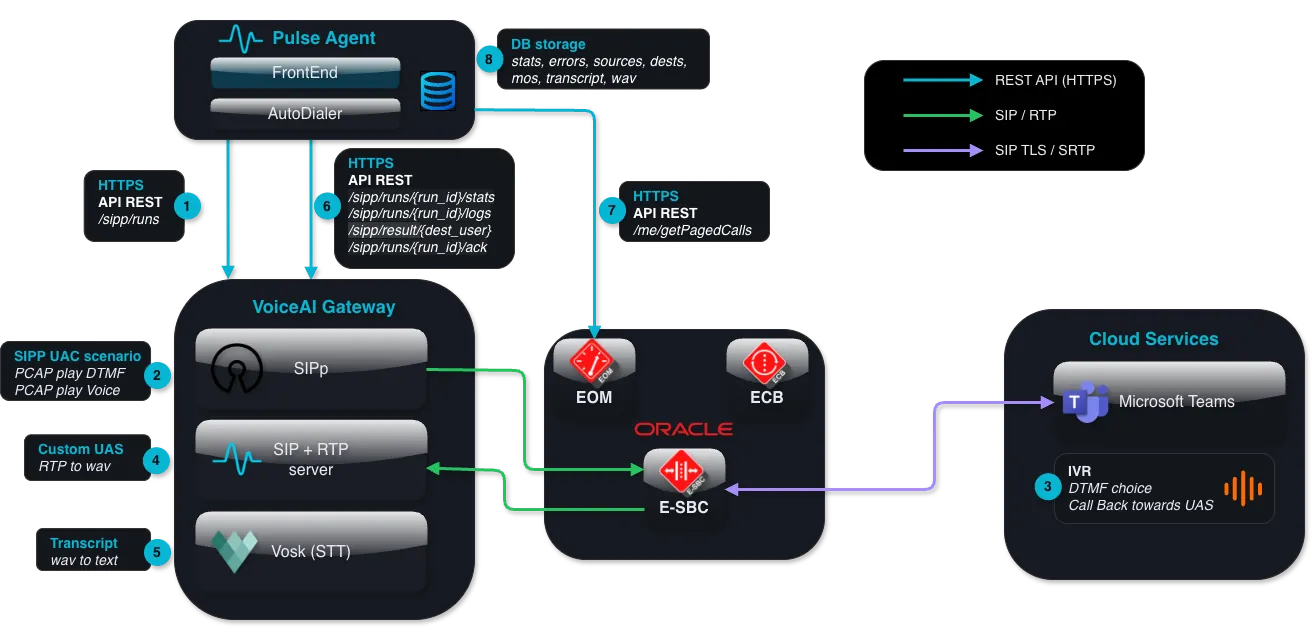
Architecture in brief
- Pulse Agent — campaign scheduler, orchestration
- VoiceAI Gateway — SIPp engine, IVR scenarios, optional Vosk ASR
- Internal API — execution pilot, no more SSH
- Local SQLite — history, metrics, exports
- IT system integrations — email, webhooks (SNMP / MIB on the roadmap)
How long does it take you today to test an IVR journey end-to-end?
Personalized demo on your voice perimeter. 30 minutes. We talk concrete scenarios, not slides.
You can also go through your usual NXO contact.